

Ultimate Guide to Selecting Motorized Linear Stages for Automated Assembly
Over the past 9 years, we’ve worked closely with production engineers, system integrators, and factory managers. One question keeps coming up.
“How do I choose the right motorized linear stage to integrate with an automated positioning stage on my motorized assembly table for high-precision automated assembly?”
That is exactly what this guide will answer. No fluff. Just practical, real-world advice you can use today.
We design and build manual stages, motorized stages, and full automated positioning stage systems. We’ve seen what works and what fails. This guide puts all that experience in one place.
What Is a Motorized Linear Stage?
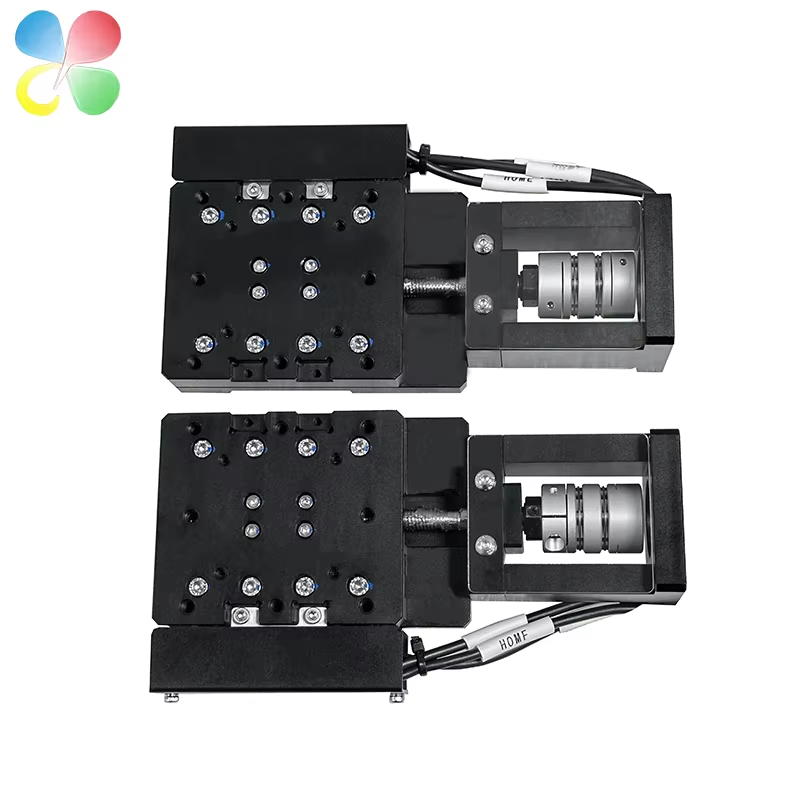
A motorized linear stage is a precision motion component. It moves a load in a straight line. The motion is driven by a motor, not by hand. You’ll find these stages inside automated inspection systems, laser marking machines, dispensing robots, and more.
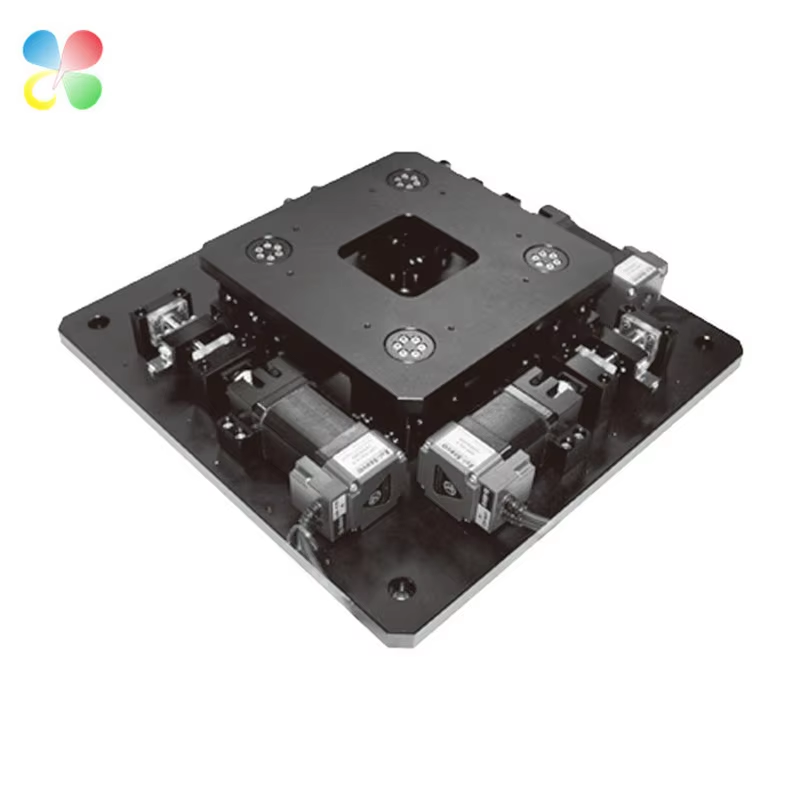
Think of it as a smart building block. You mount a camera, a gripper, a dispensing valve, or a probe on top. The stage moves it to an exact position, stops, and holds. Repeatability is often down to a few microns.
Common drive types we manufacture:
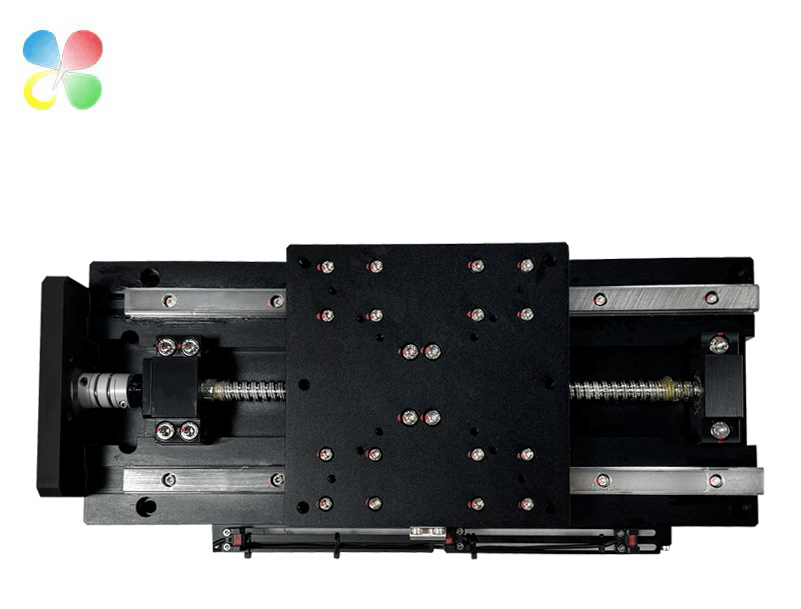
Ball screw driven stages
Lead screw driven stages
Belt driven stages
Linear motor stages
Each type fits a different budget, speed, and accuracy need. We’ll cover that in detail later.
Motorized Linear Stage vs. Automated Positioning Stage – Clarifying the Confusion
Many engineers ask us: “What’s the difference between a motorized linear stage and an automated positioning stage?”
This confusion is normal. The terms often overlap. Let’s break it down simply.
| Feature | Motorized Linear Stage | Automated Positioning Stage |
| Primary function | Single-axis linear motion | Multi-axis coordinated positioning |
| Typical configuration | One motor, one carriage, one rail | Stack of two or more stages (X-Y, X-Y-θ) |
| Control complexity | Simple – one axis controller | Higher – needs coordinated motion control |
| Common use | Feed, eject, focus adjustment | Alignment, bonding, optical assembly |
| Cost | Lower entry cost | Higher due to added axes and control |
| Our manufacturing range | Travel from 15 mm to 1200 mm | X-Y tables, gantry systems, alignment platforms |
A motorized linear stage is a building block.
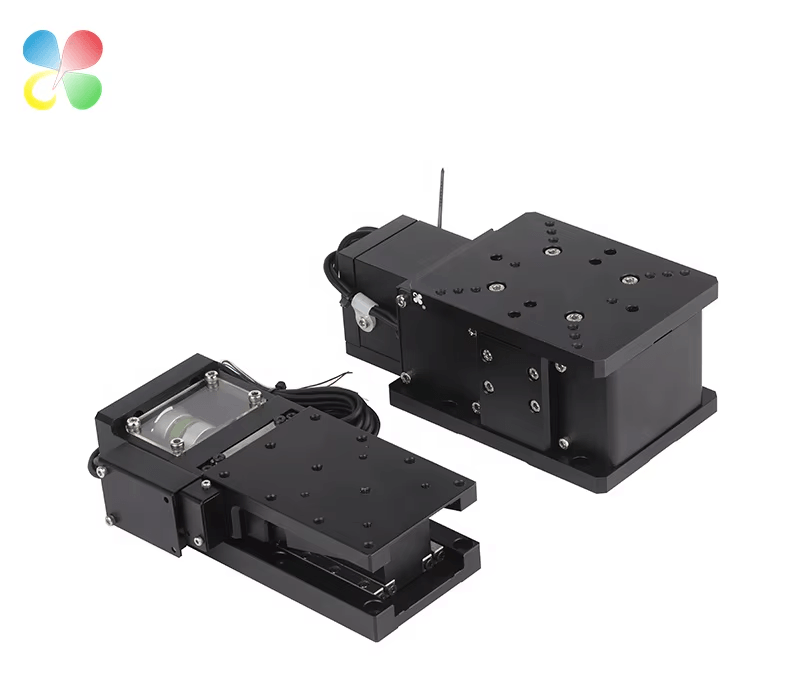
An automated positioning stage is often a system built from those blocks. For instance, our X-Y precision alignment platform combines two linear stages and sometimes a rotary stage. That whole system becomes an automated positioning stage.
If you’re building a motorized assembly table, you will likely use several linear stages plus a positioning stage. Knowing the difference helps you specify the right parts.
The Role of a Motorized Assembly Table in Modern Production
A motorized assembly table is the heart of many automated lines. It brings speed, repeatability, and data feedback to manual assembly processes.
We see motorized assembly table designs used for:
Smartphone camera module alignment and bonding
Automotive sensor assembly
Medical device component insertion
PCB screw driving and soldering
The table usually integrates one or more automated positioning stage systems. A camera finds the part. The control software calculates offset. The motorized linear stage adjusts the position. This happens in under a second.
Why upgrade to a motorized table?
Manual assembly suffers from operator fatigue. Precision drops over a shift.
A motorized table maintains ±2 µm repeatability for 24 hours.
Data logging improves traceability.
One motorized table often replaces two to three manual stations.
We’ve helped clients cut assembly rejection rates by over 60% after switching from manual stages to motorized systems.
Key Factors for Selecting a Motorized Linear Stage
Choosing a motorized linear stage is not about picking the shiniest catalog item. You need to match the stage to your real application. We always ask our clients these seven questions.
1. What is your payload?
Payload includes the weight of your tool, sensor, bracket, and cables. Never select a stage for exactly your payload. Add at least 30% safety margin. Centered load is different from cantilevered load. If your load hangs far from the carriage, effective moment load increases. We can help calculate this.
Typical ranges we offer:
Light duty: up to 5 kg (compact ball screw stage)
Medium duty: up to 30 kg (wide rail, ball screw)
Heavy duty: up to 150 kg (rigid profile, linear guide)
2. What stroke (travel) do you need?
Stroke is the total linear movement. Our standard strokes range from 15 mm to 1200 mm. Don’t buy a longer stage than necessary. Longer stages cost more and can reduce stiffness. But always add a small buffer to avoid hard stops.
3. What accuracy and repeatability?
We measure bidirectional repeatability. For a precision automated positioning stage used in laser bonding, you might need ±1 µm. For a pick-and-place motorized assembly table, ±10 µm can be enough. Check your process tolerance. Use the 10:1 rule: the stage should be 10 times more precise than your tolerance band.
Actual numbers from our standard ball screw stages:
Repeatability: ±3 µm (standard), ±1 µm (high-precision grade)
Positioning accuracy: ±10 µm / 300 mm (standard), ±3 µm / 300 mm (with linear encoder)
4. What speed and acceleration?
Speed influences cycle time. Belt-driven stages can run at 2000 mm/s. Ball screw stages usually top out around 500 mm/s. However, ball screw stages offer higher stiffness for stop-and-hold applications. A good motorized linear stage for assembly often balances speed with settling time.
5. What is the required duty cycle?
Will the stage run 8 hours a day, 24/7, or just a few moves per batch? High duty cycle applications demand robust guides and motors. We often recommend linear motor stages for 24/7 scanning. They have no mechanical wear from rotary-to-linear conversion.
6. What environment will the stage live in?
Cleanroom? Dusty factory floor? High temperature? We provide options:
Grease for cleanroom class 100
Protective bellows and covers
Corrosion-resistant materials
7. How will you control it?
We supply plug-and-play stages with stepper or servo motors and matched drivers. Controllers can be simple pulse-direction boxes or networked EtherCAT motion controllers. If you are building a motorized assembly table with multiple axes, a centralized motion controller saves wiring and software effort.
Quick Selection Reference Table
Save this table for your next project. It summarizes our most popular motorized linear stage series.
| Series | Travel (mm) | Payload (kg) | Max Speed (mm/s) | Repeatability (µm) | Drive Type | Typical Use |
| LT-60B | 30 – 300 | 5 | 300 | ±3 | Ball screw | Vision alignment |
| LT-90H | 50 – 500 | 20 | 200 | ±2 | Ball screw | Dispensing, bonding |
| LT-120L | 100 – 800 | 50 | 500 | ±3 | Ball screw | Heavy tool positioning |
| BT-80 | 200 – 1200 | 10 | 2000 | ±20 | Belt drive | High-speed transfer |
| LM-100 | 50 – 600 | 15 | 1500 | ±1 (encoder) | Linear motor | 24/7 scanning |
Need a custom combination? We routinely build X-Y, X-Z, and gantry configurations for automated positioning stage needs. Just reach out.
Application Spotlight: Automated Precision Alignment Assembly
Let’s zoom into one high-value application: Automated Precision Alignment Assembly.
This process is everywhere in optics, photonics, and micro-electronics. A lens must align with a sensor. A waveguide must align with a fiber. Tolerances are often under 5 µm in X, Y, and theta.
A typical Automated Precision Alignment Assembly cell looks like this:
A motorized assembly table holds the bottom part on an X-Y-θ stage.
A second Z stage holds the top part.
A vision system measures the offset.
The control software commands the automated positioning stage to correct position.
UV curing or laser welding fixes the parts.
We built a 5-axis system for a camera module manufacturer. The core was our LT-90H crossed-roller motorized linear stage pair, topped with a direct-drive rotary. The customer achieved 1.5 µm post-bonding accuracy. Cycle time: 4.2 seconds per unit.
If you do Automated Precision Alignment Assembly, your motorized linear stage choice is critical. You need:
High resolution (0.1 µm or better typical)
Minimal backlash (preloaded ball screw or linear motor)
Good straightness and flatness
Closed-loop feedback with linear encoder
We often guide clients to linear motor stages here. Yes, they cost more upfront. But they eliminate screw wear, backlash, and periodic maintenance. Over a 3-year period, the total cost of ownership often drops.
How to Integrate Everything into Your Motorized Assembly Table
So you have a motorized linear stage, an automated positioning stage, and a motorized assembly table concept. How do they all connect?
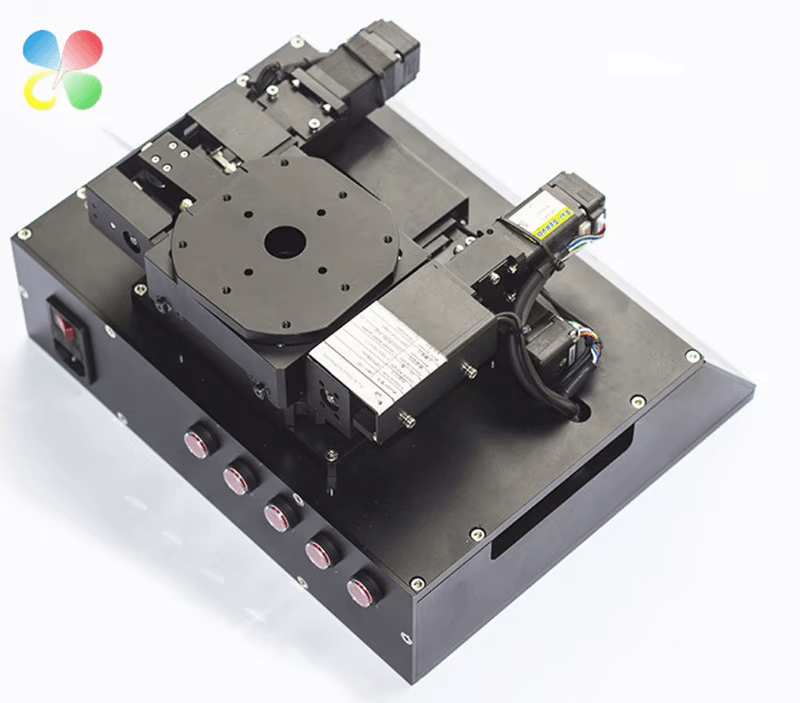
Base plate design. A rigid, stress-relieved aluminum or granite base keeps all axes aligned. We can provide the base plate with mounting holes matched to your stages.
Cable management. Moving cables cause drag. We use flexible cable chains and route cables along the stage body. For multi-axis automated positioning stage setups, proper cable management reduces failure by over 40% based on our field data.
Home and limit sensors. Every motorized linear stage should have home and over-travel limit sensors. We fit them as standard. This prevents crash damage.
Software integration. Many motion controllers offer LabVIEW, C#, or Python APIs. We provide startup code examples. If you need help writing the alignment algorithm, our application engineers can support you.
Safety. A motorized assembly table usually needs light curtains or safety interlocks. Keep that in mind during mechanical design.
Common Mistakes We See (and How to Avoid Them)
After 9 years, we’ve seen almost every mistake possible. Here are the top five.
Mistake 1: Buying based on lowest price.
A cheap stage without proper support can cost you 10x in downtime. We’ve replaced many no-name stages with ours. Long-term reliability wins.
Mistake 2: Ignoring moment loads.
A stage might be rated for 20 kg vertical load, but a side load of just 5 Nm can bind the bearings. Always calculate moment. Ask us for the load-moment diagram.
Mistake 3: No feedback on positioning.
Open-loop stepper stages lose steps under unexpected force. For critical automated positioning stage applications, add an encoder. The difference in reject rate can be staggering.
Mistake 4: Wrong drive choice for duty cycle.
Belt drives stretch. Screw drives wear. If your motorized assembly table cycles every 2 seconds 24/7, specify the drive for that life. We help you calculate lifetime in kilometers of travel.
Mistake 5: Not testing the complete system before ordering volume.
We always recommend buying one prototype stage. Test it with your real load, at your real speed. It’s a small investment that prevents large-scale errors.
Why Source from a Manufacturer with 9+ Years of Experience?
You can find motorized linear stage suppliers everywhere. What makes the difference?
Direct manufacturing. We machine the base, assemble the rails, and mount the motor in our own facility. That means full control over quality and lead time. You’re not buying a rebranded import.
Custom builds without custom prices. Need a special stroke? Vacuum-compatible materials? We can adapt quickly. Because we control the machining, one-off customizations are our strength.
Deep application knowledge. We’ve supplied automated positioning stage systems for medical, optical, semiconductor, and general industrial assembly. This means your project benefits from 9 years of cross-industry insights.
Pre-sales support. Our engineering team will review your concept, calculate loads, and propose an optimal configuration. You get a numbered specification document, not just a quote.
After-sales care. We stock spare parts. If a problem ever arises, we troubleshoot via video call within 24 hours. Many of our clients have been with us for over 5 years.
If you’re designing a new motorized assembly table or upgrading an old one, let’s talk. We’ve seen the roadblocks before and can save you months of trial and error.
Real-World Performance Numbers
I always like to share numbers. Here’s data from an actual motorized linear stage we built for a customer’s vision-guided motorized assembly table.
| Parameter | Value |
| Axis configuration | X-Y dual motorized linear stage + rotary |
| X-Y travel | 100mm x 100 mm |
| Payload capacity | 10 kg |
| X-Y repeatability | ±1.5 µm |
| Rotary resolution | 0.01° |
| Move and settle time (2µm full step) | 10mm/sec |
| System uptime over 12 months | 99.4% |
| Average positioning drift per month | <0.5 µm |
These aren’t lab numbers. This is from a running production line, 16 hours a day. The automated positioning stage performed flawlessly for high-precision adhesive dispensing. The customer’s previous manual process had a ±25 µm variation and a much higher reject rate.
If you need numbers like these for your Automated Precision Alignment Assembly, we can design a solution that hits your targets.
Frequently Asked Questions
Q: How do I choose the right motorized linear stage to integrate with an automated positioning stage on my motorized assembly table for high-precision automated assembly?
A: Start by defining your payload, stroke, repeatability, and cycle time. Then decide if you need single-axis simplicity or a multi-axis automated positioning stage. Match the drive type (screw, belt, linear motor) to your duty cycle. Finally, test with a prototype. Our engineers can walk you through a 30-minute selection call.
Q: Can I use a motorized linear stage as a standalone device?
Absolutely. Many clients use a single motorized linear stage for simple feeding or focusing. When you need X-Y or XYZ motion, you bolt stages together into an automated positioning stage.
Q: What maintenance does a motorized assembly table need?
Periodic lubrication, checking bolt torque, and verifying limit sensors. Our stages are designed for easy access. We provide maintenance schedules.
Q: Do you offer training and installation support?
Yes. We provide remote installation guidance, user manuals, and on-site support if required. Just ask.
Ready to Specify Your Motorized Linear Stage?
Choosing the right motorized linear stage for your motorized assembly table doesn’t have to be overwhelming. Break it down by payload, precision, speed, and environment. Use the tables in this guide as a checklist.
If you’re still unsure—or you have a unique Automated Precision Alignment Assembly challenge—reach out to our team. We’ve been building automated positioning stage systems for 9 years. We’ll help you select the right stage, configure the motion, and integrate it smoothly.
Contact us today for:
Free application review
Custom 3D concept drawing
Lead time and pricing within 48 hours
Tell us about your project. We’ll respond with honest, experience-backed advice. No hard sell. Just engineering support from a team that builds stages every day.
Let’s get your motorized assembly table moving with the accuracy your product demands.
Post time: Aug-03-2026


