

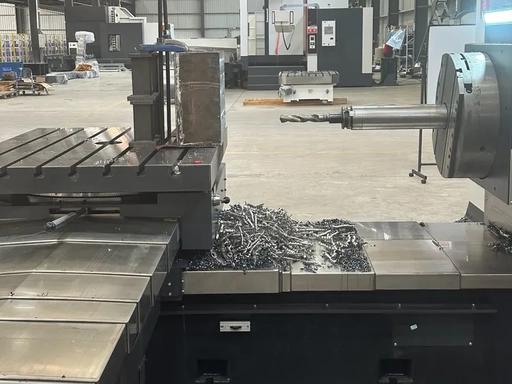
Let me start with a story. A few years back, a customer called us frustrated. They had a CNC drilling cell that was supposed to hold ±0.01 mm on a hole pattern. Monday morning, everything ran fine. By Thursday afternoon, parts were drifting. They checked the spindle, the tool holders, the coolant temperature. Nothing fixed it.
Turned out the problem was the X-Y table under the fixture. It was a cheap manual slide someone had bolted a stepper motor to. No preload, no encoder, no real rails. It moved, but it didn’t come back to the same spot twice.
That’s when I realized how many shops overlook one simple thing: the positioning stage is just as important as the cutting tool. If you can’t trust the stage to return to the same point every cycle, your whole process falls apart.
This post is about ball screw linear stage systems and why they’re the go-to choice for high repeatability positioning in CNC machining. I’ll also compare them to linear motor stages and share some real numbers so you can make a smart buying decision.
Repeatability vs. Accuracy: Don’t Mix Them Up
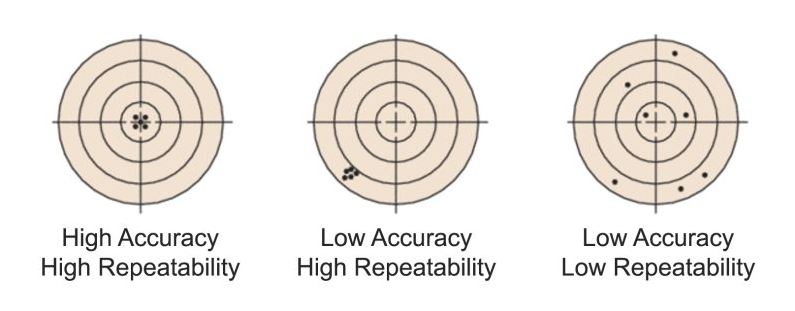
A lot of people use “repeatability“ and “accuracy“ like they’re the same thing. They’re not.
Accuracy means the stage goes exactly where you tell it to — move 50.000 mm and land at 50.000 mm. Repeatability means the stage goes to the same place every time, even if that place is 49.998 mm instead of 50.000 mm. In CNC work, repeatability often matters more. Here’s why.
You dial in a fixture offset. You drill a test hole, measure it, and adjust the offset. After that, you don’t care much about absolute accuracy — the controller has already compensated for the error. What you need is for the stage to hit that exact same spot on every single part. If it doesn’t, your hole pattern wanders.
A good ball screw linear stage will give you repeatability in the range of ±0.5 µm to ±2 µm. That sounds tiny, and it is. But in a shop environment, holding that over thousands of cycles takes real engineering.
How Do Ball Screw Driven Motorized Linear Stages Maintain High Repeatability Positioning in Multi-Axis CNC Machining?
This is the big question. Let me break it down in plain language.
The screw itself and preload
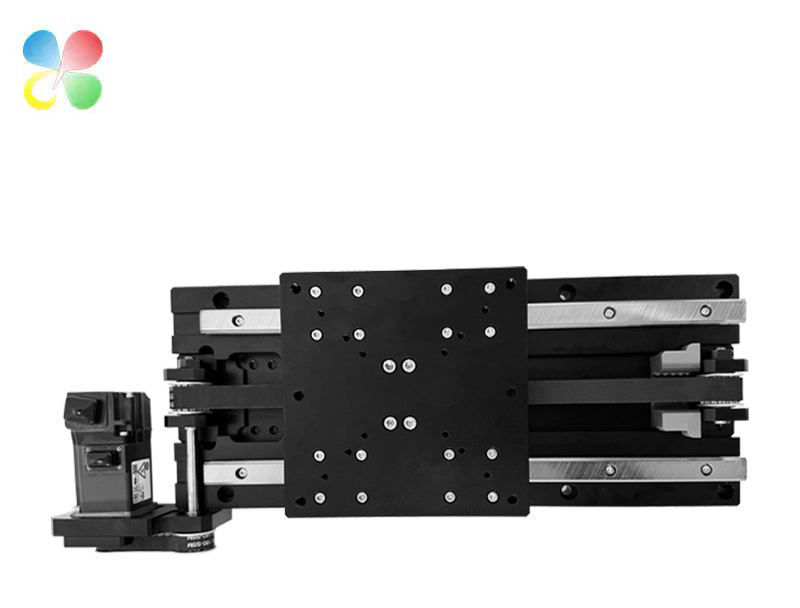
A ball screw works by rolling balls between the screw shaft and the nut. That cuts friction way down compared to a plain lead screw. But the secret sauce for repeatability is preload.
Standard rolled screws often have 20–40 µm of backlash. That means when you change direction, the nut moves a little before the carriage follows. In a CNC fixture, that shows up as position drift every time the axis reverses.
The fix is a preloaded nut — usually a double nut with a spacer or a spring-loaded single nut. It squeezes the balls tight so there’s no free play. On a good motorized precision stage, you’ll see backlash specs under 1 µm. That’s basically zero for most machining tasks.
I always tell customers: don’t buy a stage without checking the screw grade and preload type. C7 rolled screws are fine for low-precision slides, but they’re not enough for high repeatability positioning. You want C5 or C3 ground screws with a preloaded nut.
Rail rigidity matters too
The ball screw is only half the picture. The stage rides on linear guide rails. If those rails are loose or the base plate flexes, the carriage will pitch, roll, and yaw under load. Even a tiny bit of angular error at the rail translates into position error at the tool point.
Most precision stages use medium or high preload rails. The higher the preload, the stiffer the system. But don’t overdo it—too much preload increases friction and wear. A good manufacturer balances this.
Encoders: closed loop or open loop?
A stepper motor alone doesn’t know if it has lost steps. If the screw binds or the load shifts, the motor thinks it’s at the right spot, but the carriage isn’t. That’s a repeatability killer.
Adding a rotary encoder on the motor helps, but it doesn’t see backlash or screw windup. For true high-repeatability positioning, you need a linear encoder mounted directly on the carriage. It measures the actual position and feeds that back to the controller.
Yes, it costs more. But if you’re running unattended CNC production, the extra money is cheap insurance.
Multi-axis stacking errors
When you stack two or three stages into an X-Y or X-Y-Z system, the errors add up. If your X axis repeats to ±1 µm and your Y-axis repeats to ±1 µm, the total radial error at the work point can be around ±1.4 µm. That’s just geometry.
So when I design a multi-axis ball screw linear stage system for a customer, I always spec each axis a little tighter than the final requirement. For example, if the customer needs ±2 µm overall, I’ll target ±1 µm per axis. That leaves margin for mounting, temperature, and wear.
Real Application: CNC Fixture Alignment and Repeatable Workpiece Positioning
Let’s talk about a specific job: CNC fixture alignment and repeatable workpiece positioning. This is where motorized stages really shine.
Imagine a shop that machines small aluminum housings. The part has a hole pattern that changes from one customer to the next. With a fixed fixture, every new job means swapping plates, re-indicating, and hoping the operator got it right. Setup takes 30 minutes or more.
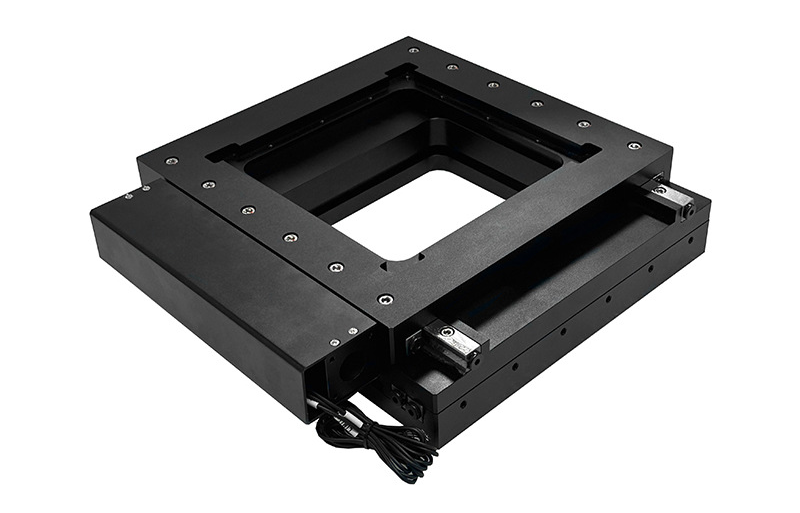
Now, put a motorized precision stage under the fixture. The operator loads the part, the CNC program moves the stage to the stored X-Y offset for that part number, and machining starts. Changeover drops to a couple of minutes. And because the stage returns to the same position every time, you don’t need to re-measure the fixture.
One of our customers in the automotive sensor business did exactly this. They replaced a manual slide with a closed-loop ball screw linear stage. Their scrap rate dropped by about 2%, and setup time went from 35 minutes to under 6 minutes per job. The payback was less than three months.
Another customer uses a motorized stage for laser marking alignment on medical parts. They need to place a small logo on the same spot every time, within ±0.02 mm. A ball screw stage with a linear encoder handles that easily, and they’ve run over a million cycles without a hiccup.
These are not exotic applications. Any shop that does second ops, drilling, inspection, or assembly can benefit from CNC fixture alignment and repeatable workpiece positioning using a motorized stage.
Ball Screw Linear Stage vs. Linear Motor Stage: Repeatability, Load Capacity & Cost Comparison
Now the big decision: should you buy a ball screw linear stage or a linear motor stage? I get this question almost every week.
Here’s the honest answer. Linear motor stages are fantastic for speed and ultra-fine repeatability. They can hit ±0.1 µm and move at meters per second. But they’re expensive, they don’t handle heavy loads well, and they generate heat that can mess with your process.
For most CNC machining work, a ball screw stage is the practical choice. Let me put some numbers on the table.
| Parameter | Ball Screw Linear Stage | Linear Motor Stage |
| Repeatability | ±0.5 µm to ±2 µm | ±0.1 µm to ±0.5 µm |
| Typical load capacity | 10 kg to 200 kg | 2 kg to 50 kg |
| Max speed | 50–500 mm/s | 500–3000 mm/s |
| Cost per axis | $800–$5000 | $3000–$15000 |
| Rigidity under cutting force | High, self-locking | Medium, needs brake for vertical |
| Maintenance | Lubricate screw and rails | Low, but may need cooling |
Look at the load column. A ball screw stage can easily push a 50 kg fixture plus a workpiece. A linear motor stage at that load would cost a fortune and might need air bearings. And in a machine shop, you have coolant mist, chips, and dust. A sealed ball screw stage survives that environment much better than an exposed linear motor.
That said, there are cases where a linear motor makes sense. If you’re doing high-speed scanning, semiconductor inspection, or ultra-precision metrology, and your load is light, go for it. But if you’re positioning a fixture under a CNC spindle, the Ball Screw Linear Stage vs. Linear Motor Stage: Repeatability, Load Capacity & Cost Comparison almost always comes out in favor of the ball screw.
I tell customers: don’t buy a linear motor just because it sounds high-tech. Buy the stage that fits your actual load, speed, and repeatability needs. Nine times out of ten, that’s a ball screw linear stage.
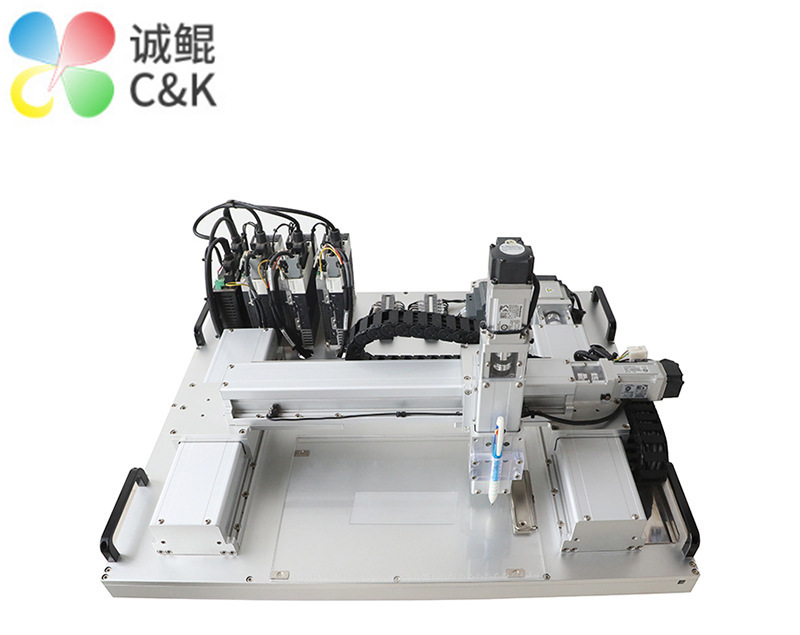
Common Mistakes That Kill Repeatability
Over nine years of building and selling stages, I’ve seen the same mistakes over and over. Here are the big ones.
1. Wrong screw grade. A C7 rolled screw with no preload will never give you micron repeatability. Don’t even try. Spend the extra money on a C5 or C3 ground screw. It’s the foundation of the whole stage.
2. Skipping the encoder. Some people buy a cheap stepper stage without an encoder, then wonder why the position drifts after a few thousand cycles. A closed-loop system with a linear encoder is the only way to guarantee high repeatability positioning over the long term.
3. Uneven mounting surface. If you bolt a precision stage to a warped machine bed, you’ll bend the base. The rails will bind, the repeatability will tank, and you’ll blame the stage. Check the mounting surface with a dial indicator before you install anything. A flat subplate is worth every penny.
4. Ignoring temperature changes. Steel expands about 3.6 µm per meter per degree Celsius. If your shop temperature swings 5°C from morning to afternoon, a 300 mm screw will move about 5.4 µm. That’s enough to scrap a tight-tolerance part. Use a linear encoder or keep the shop temperature stable.
5. Forgetting lubrication. Ball screws and linear rails need grease or oil. Dry screws wear fast and lose preload. Follow the manufacturer’s maintenance schedule. It’s boring but necessary.
6. Buying on price alone. I get it — budgets are tight. But a $500 stage that can’t hold position will cost you way more in scrap and rework than a $1500 stage that works. Buy the spec, not the price.
How to Pick the Right Motorized Precision Stage
If you’re not sure where to start, here’s a simple process I walk my customers through.
First, figure out your payload. Include the fixture, the workpiece, and any brackets. Add a safety factor of 1.5 to 2. If your load is 30 kg, spec a stage rated for at least 45 kg. Cutting forces matter too—if the stage moves while the tool is engaged, you need extra rigidity.
Second, determine your travel. Measure the longest move and add 10–20% for clearance. Don’t buy a stage that’s exactly at the limit; leave room for setup and unexpected offsets.
Third, be honest about repeatability. Do you really need ±0.5 µm, or is ±5 µm fine? Every micron of extra precision costs money. For most CNC fixture positioning, ±1 µm to ±2 µm is the sweet spot. Don’t over-spec.
Fourth, choose the drive type. If your load is under 50 kg, speed is moderate, and you care about cost, a ball screw linear stage is the default answer. If you need nanometer repeatability or speeds above 500 mm/s, then look at linear motors or other options.
Fifth, think about the environment. Machine shops are dirty. Coolant spray, chips, dust — all of that gets into open stages. Look for sealed covers, bellows, or fully enclosed designs. A motorized precision stage with an IP54 or higher rating will last much longer.
Finally, talk to the manufacturer early. Don’t wait until your fixture is built and the CAD model is frozen. A 15-minute call can save you weeks of redesign. We often help customers pick the right screw pitch, encoder type, and mounting pattern before they finalize their design.
What We Bring to the Table
We’re not a reseller. We design and build manual and motorized stages in-house, including ball screw linear stage systems, alignment platforms, and custom positioning solutions. Over the past nine years, we’ve supplied stages to machine shops, system integrators, and OEMs in automotive, medical, electronics, and aerospace.
What does that mean for you? It means we can match the screw grade, encoder, travel, and mounting to your exact CNC application. We can also send you a test report showing the repeatability of the specific stage we recommend—not just a generic spec sheet.
If you’re working on a project that needs high repeatability positioning, especially for CNC fixture alignment and repeatable workpiece positioning, reach out. Tell us your travel, load, and repeatability target. We’ll get back to you with a straight recommendation and a quote within one business day.
No pressure, no pushy sales. Just real engineering help from people who understand what happens on a shop floor.
Final Thoughts
Repeatability isn’t a luxury in CNC machining. It’s the difference between shipping good parts and sorting through scrap. A well-built ball screw linear stage gives you that repeatability without breaking the bank.
Remember the basics: pick a ground C5 or C3 screw with preload, add a linear encoder, mount the stage on a flat surfacerface, keep it lubricated, and talk to the manufacturer before you finalize the design.
If you’re tired of chasing position drift or spending hours on fixture setup, a motorized precision stage might be the upgrade you need. We’d be happy to help you pick the right one.
Contact us today. Let’s get your positioning right the first time.
Post time: Sep-08-2026


