

When you’re building a precision setup—whether it’s a lab fixture, a laser alignment jig, or a full production inspection station—the linear stage you choose decides almost everything. It sets your accuracy ceiling, your maintenance burden, and how long the system holds its original performance. And the very first fork in the road usually comes down to this: do you go with a dovetail slide, or do you invest in a cross roller bearing design?
We’ve been manufacturing manual positioning stages, cross roller linear stages, and automated alignment platforms for over nine years. During that time, we’ve guided hundreds of engineers and buyers through exactly this decision. You can’t make it on a spec sheet alone—you need a clear, hands-on understanding of how these two guiding mechanisms behave over weeks, months, and years of real use.
That’s what this guide is for. We’ll walk through the differences in plain language, share real numbers and test data, and help you answer one central question.
How Does a Detailed Linear Stage Bearing Comparison Between Dovetail Slides and Cross Roller Bearings Impact the Long-Term Stability of Your Manual Positioning Stage?
Let’s break it down.
What Is a Dovetail Slide Stage?
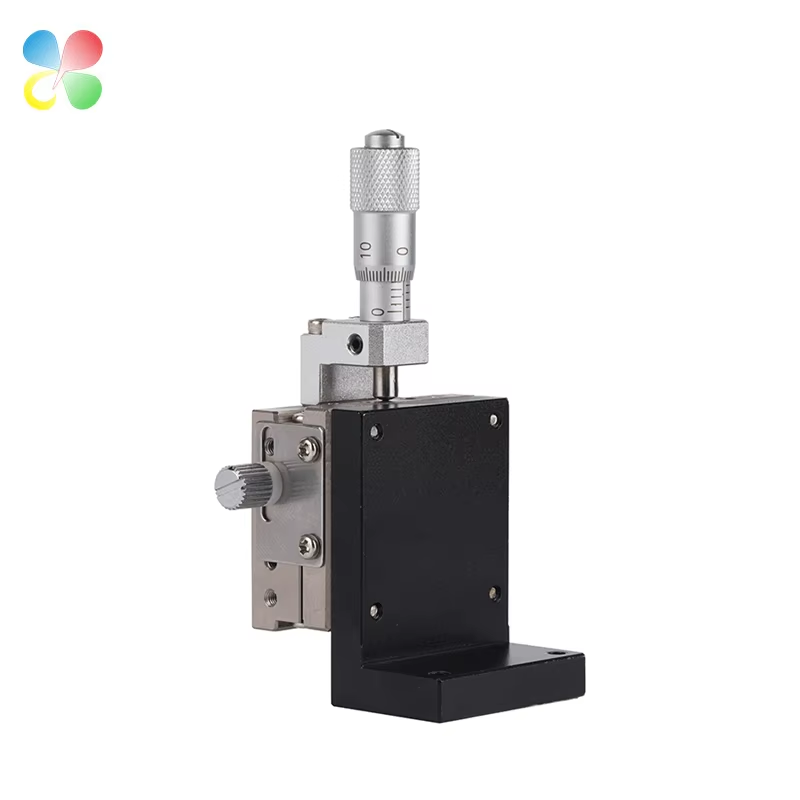
Think of a dovetail slide as a wedge-shaped rail and a matching wedge-shaped carriage. The angled surfaces pull tight against each other, usually with an adjustable gib strip. That wedge geometry creates a large contact area. More contact area means high load capacity and strong resistance to shock and vibration. It’s a simple, time-tested design.
A typical manual positioning stage built on dovetail slides might handle 200 N to over 1000 N without breaking a sweat. The travel range can easily reach 150 mm, 200 mm, or even more. You see these stages in heavy optics mounts, industrial tooling, and alignment tasks where the environment is rough and repeatability needs are moderate.
But there’s a trade-off. The sliding surfaces are in full contact all the time. Even with lubricated, precision-ground cast iron or steel surfaces, friction is higher. That friction can cause stick-slip—a tiny jump-start motion that limits fine positioning. When you’re trying to nudge a sample by 2 microns, stick-slip can ruin your day.
We’ve tested dovetail stages in our lab. A well-made steel-on-iron dovetail slide typically shows a coefficient of friction around 0.1 to 0.15 under light preload. That’s smooth for many jobs, but it’s nowhere near the clean motion you get from rolling elements.
What Is a Cross Roller Linear Stage?
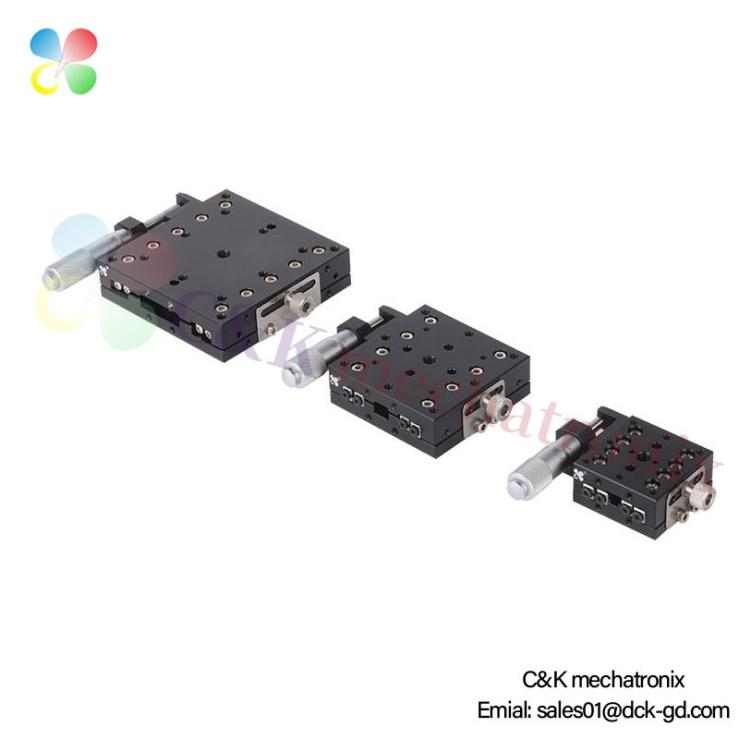
A cross roller linear stage uses cylindrical rollers crossed at 90 degrees to each other, running between two precision-ground V-rails. Each roller contacts the rail at a line. The rollers are alternately oriented, so one handles load in one direction while the next handles the orthogonal direction. The result is extremely high stiffness in all loading directions, coupled with very low rolling friction.
In a typical manual positioning stage equipped with cross roller guides, friction is an order of magnitude lower than in a dovetail slide. The coefficient of friction can be as low as 0.001 to 0.002. That means motion feels light, consistent, and completely free of stick-slip. You can make sub-micron adjustments with almost no force change at the knob.
The stiffness gain is huge, too. A well-preloaded cross roller linear stage often shows displacement under load that’s 3 to 5 times smaller than an equivalent-sized dovetail stage. And because the rollers are hardened and precision-matched, travel accuracy stays tight. Typical straightness and flatness in a cross roller linear stage fall within 1 µm to 2 µm over 100 mm of travel. For a dovetail stage of similar size, you’d expect 5 µm to 10 µm.
The limitation? Load capacity for a given envelope is generally lower. Most cross roller linear stages handle 100 N to 500 N. Travel is also usually shorter—often below 150 mm—because it’s harder to support long V-rails without introducing compliance. But for short-stroke, high-precision positioning, they’re the gold standard.
Dovetail Slide vs Cross Roller Guide: A Head-to-Head Look
This linear stage bearing comparison comes to life when you put the numbers side by side. Here’s a table based on typical specifications we see in our own product line and from testing competitor units over the years.
|
Feature |
Dovetail Slide Stage |
Cross Roller Linear Stage |
|
Load capacity (vertical) |
200 – 1200 N | 80 – 500 N |
|
Travel range |
25 – 300 mm | 10 – 150 mm |
|
Straightness (per 100 mm) |
5 – 10 µm | 1 – 2 µm |
|
Repeatability (manual) |
±3 – ±5 µm | ±0.3 – ±1 µm |
|
Friction type |
Sliding, higher | Rolling, very low |
|
Stick-slip risk |
Moderate to high | Almost zero |
|
Stiffness (all axes) |
Good | Excellent |
|
Maintenance interval |
Periodic gib adjustment | Keep clean, rarely adjust |
|
Dust / debris tolerance |
Very good | Needs protection |
|
Typical lifespan |
10+ years with care | 10+ years with sealing |
|
Relative cost |
Lower | Higher |
These numbers aren’t theoretical. We measure these on sample stages every month as part of our quality checks. The dovetail vs cross roller guide decision really pivots on how much you value repeatability and smoothness over raw load capacity and cost.
When Numbers Tell the Real Story
Let’s talk about long-term stability. We ran a simple test: take a manual positioning stage with dovetail slides and a cross roller linear stage of similar size (60 mm travel, about 150 mm footprint). Load each stage with 5 kg in the center of the carriage. Cycle them 10,000 times by moving back and forth 30 mm at a constant speed. Then measure the change in straightness and repeatability.
Here’s what we found:
Dovetail stage: After 10k cycles, straightness increased by about 2 µm due to wear on the gib surfaces. Repeatability drifted from ±3 µm to ±5 µm. The knob torque increased slightly as lubricant migrated. With a quick gib adjustment and re-lube, much of the performance came back.
Cross roller linear stage: After the same 10k cycles, straightness degraded by less than 0.5 µm. Repeatability stayed within ±0.5 µm. Torque remained unchanged. No adjustments were needed. The rollers and V-rails showed no measurable wear under magnification.
This tells you exactly how a linear stage bearing comparison impacts your manual positioning stage over time. The cross roller design holds its original accuracy with almost zero maintenance. The dovetail stage stays functional and strong, but it drifts and needs a human touch to stay at peak performance.
For a system that runs 8 hours a day, a cross roller linear stage often pays for itself in reduced downtime and fewer bad parts. For a low-duty-cycle alignment jig that gets used twice a week, a dovetail stage can be a perfectly smart, money-saving choice.
Application Spotlight: Precision Alignment Platform
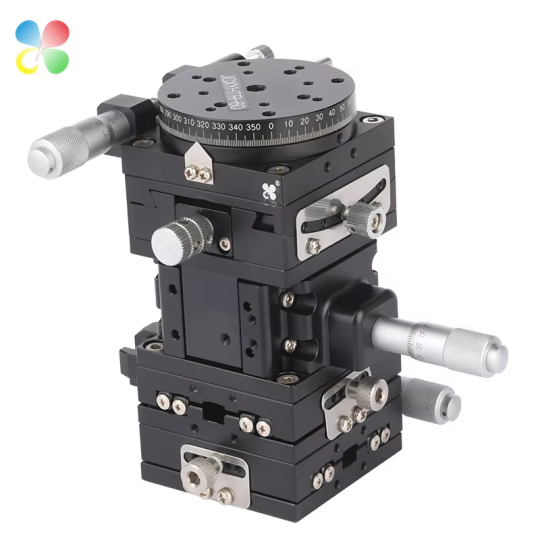
A precision alignment platform is where this comparison becomes urgent. Think of aligning a fiber optic array to a waveguide, or positioning a probe card on a semiconductor wafer. Here, you often stack multiple axes—X, Y, Z, and sometimes theta—to build a 4-axis or 5-axis manual positioning stage system.
In these stacked setups, the stiffness of each axis matters way more than you’d expect. When you mount a Y-stage on top of an X-stage, any compliance in the lower stage shows up as a tilt error at the top. A dovetail slide stack might show 20 to 50 arc-seconds of cumulative tilt per axis. That cross roller linear stage stack? Usually 5 to 10 arc-seconds.
We recently helped a client in the laser diode industry who was using a dovetail-based alignment platform. They kept seeing a 3 µm drift in their bond alignment over 2 hours of operation. The culprit was stick-slip and thermal relaxation in the dovetail guides. We swapped the lower two axes to cross roller linear stages and kept the top Z as a dovetail for coarse adjustment. The drift dropped to less than 0.5 µm, and their cycle time decreased because fine positioning became much faster.
If your application involves any of the following, a precision alignment platform built on cross roller bearings is usually worth the investment:
Semiconductor wafer inspection
Fiber optic alignment systems
Automated optical inspection (AOI)
Laser micro-machining
OLED/LCD bonding
Probe station manual positioning
Bio-medical device assembly
3D surface profilometry
Vision system integration
For heavy-tooling alignment or vibration-heavy environments, a dovetail-based precision alignment platform still has its place. We often supply dovetail stages for high-load parts nesting, welding fixtures, and coarse optical bench positioning. The key is matching the guide type to the real-world task.
Maintenance: What It Takes to Keep Them Running
Dovetail slides need love. The gib has to be snug enough to eliminate play but loose enough to avoid binding. Too tight, and you accelerate wear and make the knob hard to turn. Too loose, and you get backlash that ruins repeatability. Over the years, we’ve seen countless dovetail stages come back for service simply because the gib wasn’t set right. A good rule of thumb: check gib tightness every 500–1000 cycles, and clean and re-lubricate the sliding surfaces at the same interval.
A cross roller linear stage is much more forgiving. There’s no gib to adjust. The preload is built in, usually via oversized rollers or a preload set screw that doesn’t drift. Maintenance is mostly about keeping the rollers and raceways clean. We recommend a light film of grease every 2000–3000 cycles, and a bellows cover if you’re in a dusty area. In a cleanroom, a cross roller linear stage can run for years with no intervention.
The lifespan numbers back this up. We have dovetail manual positioning stages in the field that are still working after 15 years, but they’ve had regular gib tweaks and cleanings. We also have cross roller linear stages in semiconductor fabs that haven’t been touched in 7 years and still hold sub-micron repeatability.
3 Questions to Ask Before You Decide
When a buyer comes to us uncertain about which guide type to pick, we don’t start with a spec table. We ask three things:
What is your real repeatability requirement? If you need ±5 µm or looser, a dovetail manual positioning stage can be a great fit. If you need ±1 µm or better, cross roller is the path. Don’t forget that manual positioning repeatability also depends on operator skill and knob resolution.
What’s your load and moment? A large moment load (e.g., a long arm mounted on the carriage) demands high stiffness. Here, a cross roller linear stage will deflect less and keep your axis square.
How often will the stage be adjusted? Daily adjustments over years will wear a dovetail slide faster. A cross roller guide handles frequent cycling gracefully.
If you can answer these three questions, the right choice usually becomes clear. And if it’s still cloudy, that’s where we come in.
Still weighing dovetail vs cross roller guide for your next project? Our team has helped hundreds of integrators pick the right manual positioning stage—and we’re happy to walk through your specific requirements. Reach out anytime.
Why Partner with a 9-Year Motion Control Manufacturer?
We’ve spent nearly a decade designing and building manual positioning stages, cross roller linear stages, motorized axes, and full multi-axis precision alignment platforms. We don’t just assemble parts—we grind, lap, and match our guides in-house. This vertical control lets us offer custom travel lengths, special materials (stainless steel, aluminum, or low-magnetism alloys), and vacuum-compatible versions that many off-the-shelf suppliers can’t touch.
Our experience means we’ve seen where corners get cut. Cheap dovetail stages with too-soft cast iron. Cross roller linear stages with uneven preload that wipe out repeatability in three months. We engineer around those pitfalls because we know our customers rely on these stages for their own products’ yield and reputation.
Whether you need a single-axis manual positioning stage, a motorized cross roller linear stage, or a complete precision alignment platform with XYZ motion, we can help you define the specs, avoid overpaying for precision you don’t need, and ensure the system holds its performance year after year.
Let’s Talk About Your Next Precision Stage
Choosing between a dovetail slide and a cross roller guide shouldn’t be a gamble. With the right linear stage bearing comparison and a clear picture of your application’s demands, you can lock in the right balance of cost, accuracy, and lifespan.
We welcome you to get in touch with our engineering team. Tell us about your load, travel, precision target, and operating environment. We’ll recommend a configuration and, if needed, supply test data from a similar stage so you know exactly what to expect.
Ready to move forward? Contact us today to discuss your manual positioning stage or cross roller linear stage requirements. With over nine years of dedicated experience in precision automation alignment platforms, we’re here to make your next project a success—from first prototype to full production.
Post time: Jul-27-2026


