

Let me start with something I’ve seen too many times. A customer orders a standard aluminum positioning stage, mounts it on a fixture, and everything works great for the first hour. Then the operator takes a short break. Comes back. Turns the knob again. And the position is off. Not by a lot. Maybe 5 microns. Maybe 8. But enough to fail an inspection.
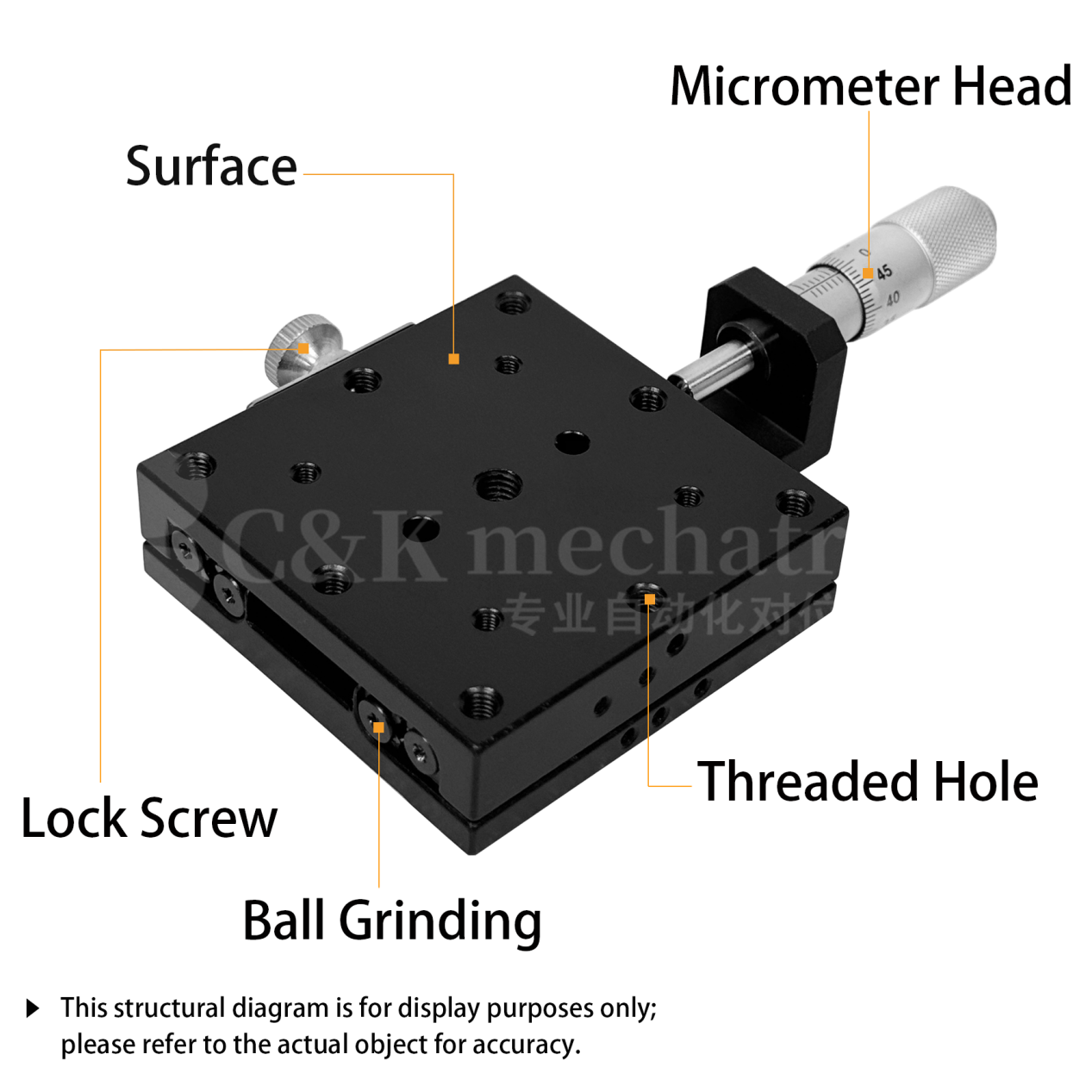
That’s thermal expansion. And if you work with precision manual stages, it’s something you’ll run into sooner or later.
We’ve been making manual and electric stages, plus automation alignment platforms, for over 9 years. During that time, we’ve helped plenty of buyers deal with drift caused by heat. This post is a practical guide to material selection and thermal behavior. I’ll keep it simple and avoid heavy theory where I can.
One question that comes up again and again is this: Can an off-the-shelf aluminum positioning stage maintain repeatable accuracy during prolonged manual operation cycles? I’ll answer that directly later. First, let’s talk about why heat even matters.
Why a Precision Manual Stage Drifts When It Gets Warm
Every material grows when heated. The rate is called the coefficient of thermal expansion, or CTE. It’s usually given in ppm/°C. That means parts per million of length change for every degree Celsius.
Aluminum 6061 has a CTE of about 23.6 ppm/°C. Let’s say you have a 100 mm long aluminum part. Raise the temperature by 1°C. It grows 2.36 µm. That doesn’t sound like much. But if your inspection tolerance is ±5 µm, one degree already eats half your budget.
Now think about a manual stage during real use. An operator grabs the knob. Hand heat flows into the lead screw. Bearings create friction. A nearby lamp or motor adds warmth. Different parts of the stage warm up at different speeds. The base might expand more than the table. The lead screw grows longer and its pitch shifts. The bearing preload changes. All of that moves the stage away from where you set it.
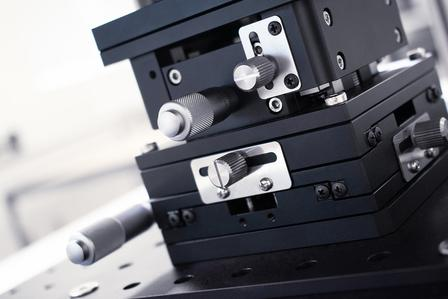
A thermal stability linear stage is designed to minimize those effects. It’s not just about using one magic material. It’s about how the whole structure balances heat and expansion. But more on that later.
Here’s a table of common stage materials and their CTE values.
|
Material |
CTE (ppm/°C) |
|
Aluminum 6061-T6 |
23.6 |
|
Aluminum 7075-T6 |
23.4 |
|
Gray cast iron |
10.8 |
|
Stainless steel 304 |
17.3 |
|
Invar 36 |
1.2 |
|
Granite |
5.0–7.0 |
The difference between aluminum and Invar is huge. Invar barely moves. Aluminum moves a lot. Cast iron sits in the middle.
Can an Off-the-Shelf Aluminum Positioning Stage Hold Up?
Let’s get back to that question.
Can an off-the-shelf aluminum positioning stage maintain repeatable accuracy during prolonged manual operation cycles?
The honest answer is: probably not, if your tolerance is tight. A standard aluminum positioning stage can be very repeatable in a temperature-controlled room for short cycles. But prolonged manual operation adds heat. And heat adds drift.
The operator’s hand is usually around 30°C to 35°C. The stage might be 20°C to 23°C. So the knob and the area near the lead screw see a local temperature rise of 8°C to 15°C. Friction in the screw adds even more heat. After 20 or 30 minutes of continuous adjustment, the stage is noticeably warmer.
That warmth spreads unevenly. The top plate expands more than the base. The screw grows. The rail preload changes. You see the position shift by a few microns. Sometimes more.
Let’s put numbers to it. The formula is simple:
ΔL = L × CTE × ΔT
ΔL is the length change. L is the original length. CTE is the coefficient. ΔT is the temperature change.
For a 150 mm long part:
|
Material |
CTE (ppm/°C) |
Error at ΔT 1°C |
Error at ΔT 3°C |
Error at ΔT 5°C |
|
Aluminum 6061 |
23.6 |
3.54 µm |
10.62 µm |
17.70 µm |
|
Aluminum 7075 |
23.4 |
3.51 µm |
10.53 µm |
17.55 µm |
|
Cast iron |
10.8 |
1.62 µm |
4.86 µm |
8.10 µm |
|
Invar 36 |
1.2 |
0.18 µm |
0.54 µm |
0.90 µm |
A 3°C rise on a 150 mm aluminum part creates about 10.6 µm of growth. If you need ±3 µm repeatability, you’re already outside the budget. That’s why a thermal stability linear stage matters for precision work.
Lightweight Aluminum Alloy (6061/7075) vs. High-Stability Cast Iron / Invar
When buyers compare materials, they usually end up looking at three main options: aluminum, cast iron, and Invar. Each has a place. None is perfect for everything.
Aluminum 6061 and 7075 – Not as Different as You Think
Most off-the-shelf stages are aluminum. It’s light, cheap, and easy to machine. 6061-T6 is the default choice. It takes hard anodizing well and resists corrosion okay. 7075-T6 is stronger and harder. It handles higher loads without getting bigger.
But here’s the thing people often miss. The CTE of 7075 is almost identical to 6061. So switching from 6061 to 7075 won’t fix a thermal drift problem. The two alloys move the same amount per degree.
The main advantage of an aluminum positioning stage is weight. A compact aluminum stage can weigh half as much as a cast iron stage with the same travel. That matters a lot on a gantry, a robot arm, or a portable inspection cart. The downside is heat. Aluminum conducts heat fast. It warms up quickly when touched, and cools down quickly when released. Those rapid changes are what cause drift during long manual cycles.
Cast Iron and Invar – When Stability Beats Weight
Cast iron has a CTE around 10.8 ppm/°C. That’s less than half of aluminum. It also has high damping. Vibrations die out quickly. That’s why machine tool bases are made from it.
Cast iron is heavy. That mass acts as a thermal buffer. It takes longer to heat up and longer to cool down. In a stable room, a cast iron stage may not notice short temperature spikes. But cast iron rusts. It needs paint, plating, or oil. It’s also harder to machine into small, complex shapes.
Invar 36 is a nickel-iron alloy with a CTE of about 1.2 ppm/°C. That’s nearly zero. If you need sub-micron stability, Invar is the gold standard. The catch? It’s expensive. It’s also a pain to machine. And it’s heavy. But for high-end Semiconductor Inspection Fixtures or optical systems, the cost is often worth it.
Here’s a comparison table to make things clearer.
| Property | Aluminum 6061 | Aluminum 7075 | Cast Iron | Invar 36 |
| CTE (ppm/°C) | 23.6 | 23.4 | 10.8 | 1.2 |
| Density (g/cm³) | 2.70 | 2.81 | 7.2 | 8.1 |
| Damping | Low | Low | High | Medium |
| Corrosion resistance | Good with anodizing | Moderate | Poor unless coated | Fair |
| Machinability | Excellent | Good | Fair | Difficult |
| Cost | Low | Medium | Medium | Very high |
| Weight | Low | Low | High | High |
I always tell customers: don’t pick a material because it sounds premium. Pick it because it matches your temperature range, your accuracy target, and your budget.
Thermal Drift in Semiconductor Inspection Fixtures: A Real Example
Semiconductor Inspection Fixtures are a great place to see thermal drift in action. These fixtures hold cameras, probes, or sensors over a wafer or PCB. They need to stay in the same position for long periods while an operator makes fine manual adjustments.
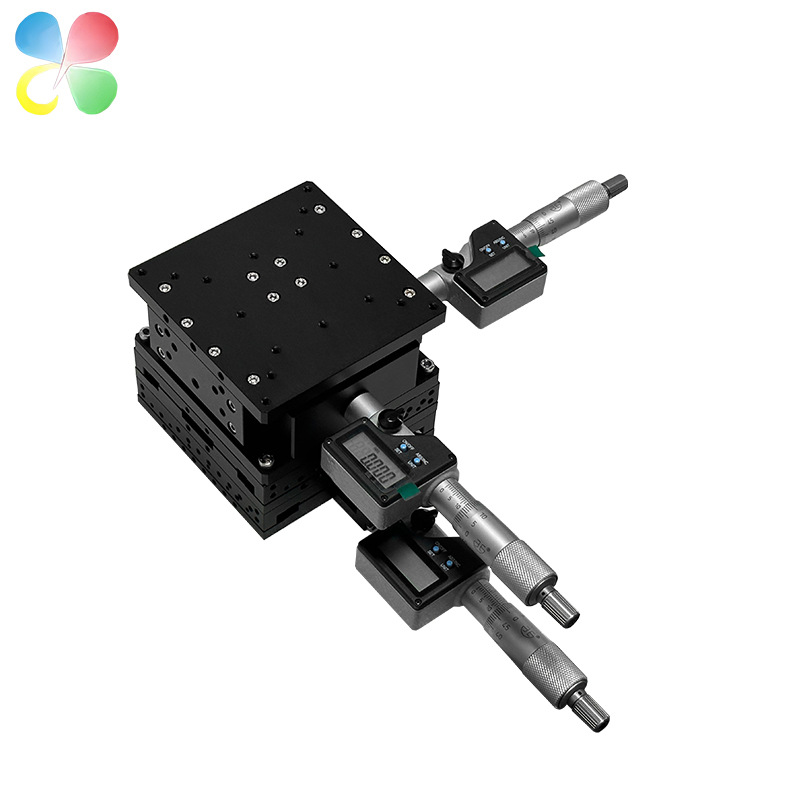
We worked with a customer who used a standard aluminum positioning stage in a semiconductor inspection fixture. The operator hand-cranked a camera over a wafer. Under 20x optics, the image drifted during a 40-minute batch run.
At first, the customer thought the stage was worn out. But the rails weren’t loose. The lead screw wasn’t sloppy. The problem was heat.
The operator’s hand was on the aluminum knob for most of the cycle. A microscope lamp nearby added extra heat. The aluminum base grew by about 8 µm over a 150 mm length. That was enough to blur the region of interest.
We made three changes. First, we replaced the aluminum knob with a plastic one. That cut hand heat transfer significantly. Second, we used a thermal stability linear stage with a stress-relieved aluminum body and Invar linear rail inserts. Third, we added thermal isolation standoffs between the stage and the lamp bracket.
Here’s what happened.
|
Condition |
Drift over 40 minutes |
|
Standard aluminum positioning stage |
8.2 µm |
|
Hybrid stage with Invar rails and plastic knob |
1.1 µm |
|
Inspection tolerance requirement |
±2 µm |
That’s a huge improvement. The customer kept using a manual stage. They didn’t need a motorized closed-loop system. They just needed the right material choices and a little thermal isolation.
If you build Semiconductor Inspection Fixtures, don’t ignore thermal drift. Even a small temperature change can cause false rejects or missed defects.
How to Improve Thermal Stability Without Spending a Fortune
You don’t always need Invar. Sometimes simple changes can make an aluminum positioning stage a lot more stable.
Small Changes That Make a Big Difference
Use low-CTE materials in the critical loop. The critical loop is the path from the moving table to the measurement point. If the base, rails, and lead screw are all aluminum, they grow together. But if the lead screw is steel and the base is aluminum, they grow at different rates. That mismatch creates tilt and lost motion.
Isolate the hand knob. Use a plastic or phenolic knob. Add a thermal break between the knob and the lead screw. This one change can reduce hand heat transfer by a surprising amount. We’ve seen it fix drift issues on its own.
Keep the design symmetric. Uneven expansion causes tilt. A symmetric stage body expands more evenly. That helps the table stay flat and parallel to the base.
Stress relieve the aluminum parts. Internal stress from machining can release slowly over time. Temperature changes speed up stress release. That causes permanent movement. Stress-relieved aluminum is much more stable in the long run.
Hard anodize the aluminum. Hard anodizing doesn’t change the CTE. But it improves wear resistance and reduces surface damage. A worn surface can change friction and make heat generation worse.
Watch the bearing preload. Too much preload increases friction heat. Too little preload reduces stiffness. Crossed roller bearings with controlled preload are a solid choice for a precision manual stage.
Control the environment. Keep the stage away from HVAC vents, direct sunlight, and hot equipment. Even a 1°C ambient change can shift an aluminum stage by several microns.
Allow warm-up time. After installation, let the stage sit for 10 to 15 minutes before making critical measurements. This lets the temperature settle.
Here’s a quick reference table for these tips.
|
Design feature |
Thermal benefit |
|
Plastic hand knob |
Reduces heat transfer from operator |
|
Invar rail inserts |
Lowers expansion in the guiding loop |
|
Symmetric body design |
Reduces tilt from uneven expansion |
|
Stress-relieved aluminum |
Prevents long-term movement |
|
Hard anodizing |
Improves wear, reduces friction heat |
|
Controlled bearing preload |
Balances stiffness and friction |
|
Thermal isolation standoffs |
Blocks heat from nearby equipment |
Choosing the Right Stage: A Few Practical Questions
If you’re unsure where to start, here are a few questions we ask every customer.
What is your tolerance? If it’s ±20 µm or looser, a standard aluminum positioning stage is usually fine. If you need ±5 µm or better, think about thermal stability from the beginning.
How long is the manual operation cycle? Short cycles under 10 minutes are less likely to cause drift. Long cycles over 30 minutes build up heat. That’s when a thermal stability linear stage really earns its keep.
What is the temperature range? A cleanroom with ±0.5°C control is easy on aluminum. A factory floor with ±3°C swings is not. Be honest about your environment.
What is the load? Aluminum works well for light loads. Cast iron is better for heavy loads and vibration damping. Invar is best for stability but not for heavy loads.
What is your budget? Aluminum is the cheapest. Cast iron is mid-range. Invar is expensive. A hybrid design can balance cost and stability.
Here’s a simple selection table we use with customers.
|
Application |
Recommended stage material |
|
General optical alignment, short cycles |
Aluminum 6061 |
|
High-load manual positioning |
Aluminum 7075 or steel-reinforced |
|
Semiconductor Inspection Fixtures, sub-micron |
Invar or hybrid aluminum/Invar |
|
Metrology base, vibration-heavy setup |
Cast iron |
|
Long manual cycles in varying temperature |
Thermal stability linear stage with low-CTE rails |
|
Portable field inspection |
Lightweight aluminum positioning stage |
We also build custom hybrid stages. One common design is an aluminum body with Invar inserts for the critical rail seats. Another is a cast iron base with an aluminum table. These hybrids give you a good balance of cost, weight, and stability.
Common Questions We Get
What is the CTE of 6061 aluminum? 6061-T6 has a CTE of about 23.6 ppm/°C. That means a 100 mm part grows about 2.36 µm for every 1°C rise.
Is 7075 more thermally stable than 6061? Not really. The CTE values are almost the same. 7075 is stronger and harder, but it won’t fix a thermal drift problem. If someone tells you otherwise, be careful.
Does hard anodizing change thermal expansion? No. The anodized layer is very thin. It doesn’t change the bulk thermal expansion of an aluminum positioning stage in any meaningful way.
Can I use an aluminum positioning stage in a cleanroom? Yes. Choose a hard anodized model with low-outgassing grease. But keep in mind that cleanroom temperature control helps a lot. If the room is stable within ±0.5°C, aluminum can work well.
How much does a thermal stability linear stage cost? It depends on size, travel, material, and bearing type. A custom Invar stage can cost 3 to 10 times more than a similar aluminum model. A hybrid aluminum stage with Invar rails is often a better value for most people.
What is the best material for Semiconductor Inspection Fixtures? For sub-micron stability, Invar or stress-relieved cast iron is best for the base and rail seats. Aluminum can be used for covers and non-critical parts. We often recommend a hybrid approach to keep costs down.
Need Help? Talk to Us
Thermal expansion is one of those things that’s easy to ignore until it bites you. A precision manual stage can look perfect on paper but drift in real use because of a few degrees of heat.
The good news is that most drift problems can be solved with the right material and a few smart design choices. You don’t always need Invar. Sometimes a plastic knob and a stress-relieved aluminum body are enough. Other times, a thermal stability linear stage with Invar rails is the only way to hit your spec.
We’ve been doing this for over 9 years. We’ve seen the same problems repeat across different industries. And we’ve learned that the best solution is usually a mix of good engineering and honest conversation about the application.
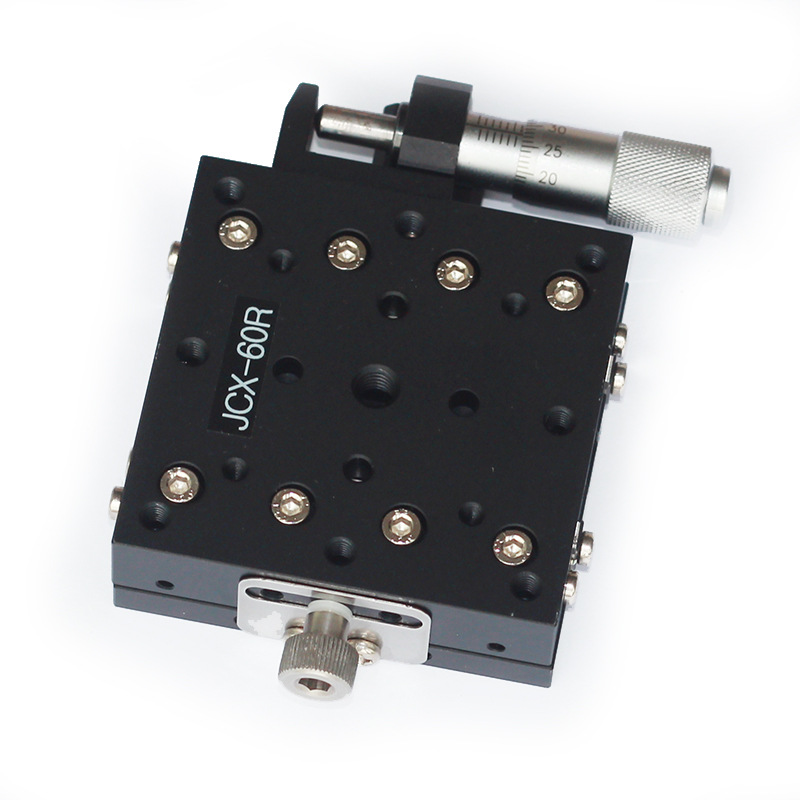
If you’re not sure which material fits your setup, send us your travel, load, tolerance, and duty cycle. We’ll help you sort it out. We build standard precision manual stage models in aluminum, and we also do custom thermal stability linear stage work with cast iron, Invar, or hybrid combinations.
Whether you’re working on Semiconductor Inspection Fixtures or a completely different application, we’re here to help. Reach out today and tell us about your project. We’ll help you find a stage that holds its position, cycle after cycle.
Post time: Aug-26-2026


