

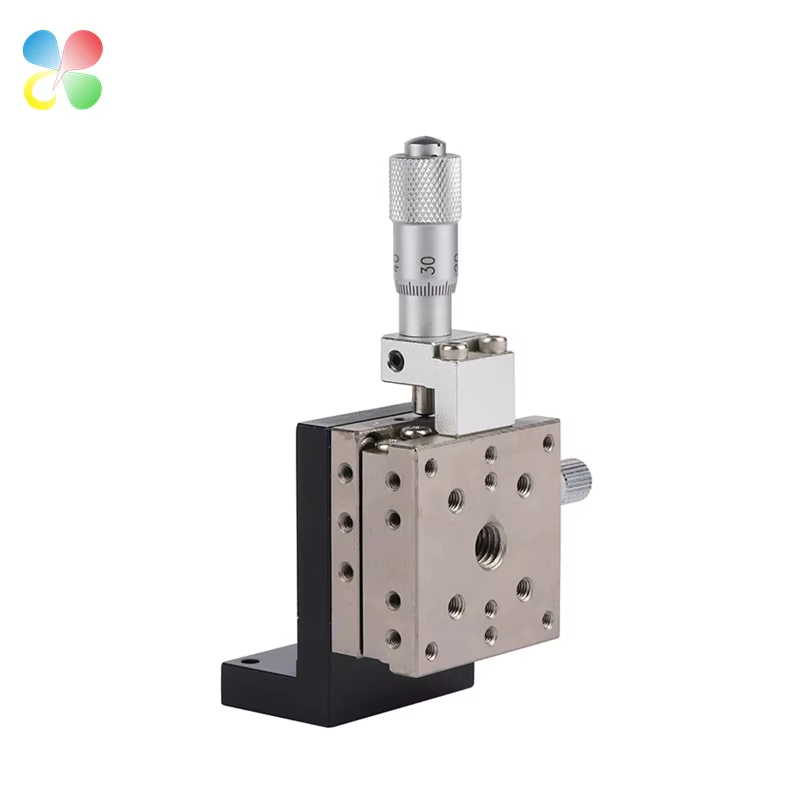
We have been designing and manufacturing manual and motorized positioning stages for over nine years. In that time, we have seen engineers and procurement teams face the same problem again and again. They need a vertical lift that can hold a heavy load without drifting. They need repeatable motion day after day. And they need all of this without breaking their budget.
This guide is for those people. We will explain what makes a vertical manual stage reliable under weight. We will give you real numbers. We will compare the two most common guide types. And we will show you exactly where heavy-load precision Z axis linear stage systems make the biggest impact, especially in fields like optical alignment and semiconductor metrology.
If you are currently sourcing a Z axis linear stage, or you simply want to understand how to maintain manual lift stage precision in a vertical manual stage under heavy cantilevered loads, this blog is built for you.
What Is a Vertical Manual Stage?
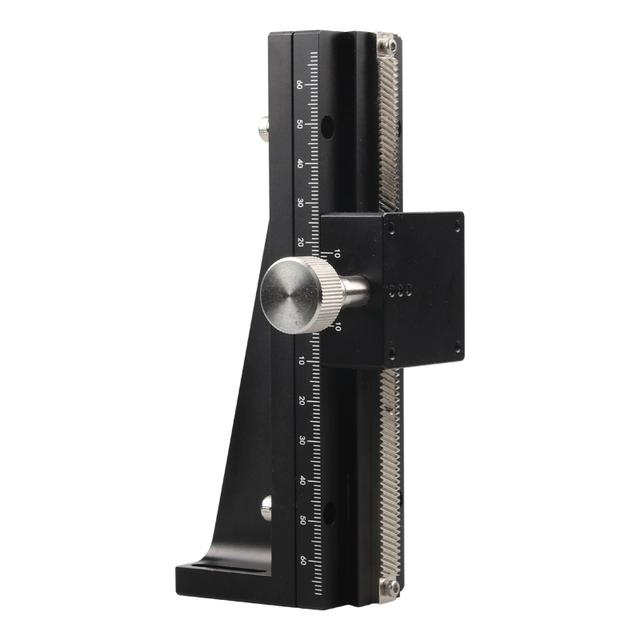
A vertical manual stage is a positioning device that moves a load straight up and down. The travel direction is vertical. You turn a knob or micrometer, and a lead screw pushes the carriage upward or lowers it.
The term Z axis linear stage means the same thing. In many multi-axis systems, the vertical axis is called Z. So when engineers talk about a Z axis linear stage, they are describing the same function. Our customers use both names, and we will use them interchangeably throughout this article.
What makes this stage unique is gravity. On a horizontal stage, the load just sits on the bearings. The screw only has to overcome inertia and friction. On a vertical manual stage, gravity pulls the load down constantly. The screw and guide system must hold the load at every position. If they do not, you lose manual lift stage precision immediately.
The Real Problem with Heavy Loads
Imagine you mount a 40 kg optical assembly on a vertical manual stage. You adjust the height to align a laser path. You let go of the knob. A few seconds later, the carriage has dropped 5 microns. By the end of the day, it has drifted 20 microns. Your alignment is gone.
This is the real-world consequence of a poorly chosen Z axis linear stage. Heavy loads amplify every weakness. Backlash becomes visible drift. Guide deflection introduces angular error. Thermal expansion can add even more drift.
When you need manual lift stage precision under these conditions, you have to think about three things at once: the lead screw pitch, the guide stiffness, and the way the load is mounted.
We have seen customers lose hours of production time because they used a stage that was rated only for horizontal use. A stage can have a high load capacity on paper. But if that rating was measured in a horizontal orientation, it means nothing for a vertical manual stage.
How to Maintain Manual Lift Stage Precision in a Vertical Manual Stage Under Heavy Cantilevered Loads
The question above is one we hear a lot. Cantilevered loads are the worst-case scenario. The center of mass hangs out in front of the carriage. This creates a moment that tries to tilt the carriage forward. If your vertical manual stage cannot resist that moment, you lose straightness and angular accuracy.
Here is how we help our customers keep manual lift stage precision in these tough conditions.
1. Choose a Self-Locking Lead Screw
The lead screw is the heart of your Z axis linear stage. Under heavy vertical load, a coarse thread can back-drive. This means the load pushes the screw backward and the carriage sinks.
A fine-pitch screw prevents this. For most applications, a pitch of 1 mm or smaller provides enough friction to hold the load without an external brake. Some of our manual lift stages use a 0.5 mm pitch for extra safety under loads above 30 kg.
Self-locking does not mean the stage is hard to turn. With proper bearing design, you still get smooth motion. But you get the peace of mind that your position will not change when you let go.
2. Demand a Stiff Guide System
The guides or bearings carry the weight and resist moments. If they flex, your manual lift stage precision suffers. You might see the carriage tilt by a few arc-seconds. That tiny tilt can translate into microns of displacement at the load point.
For cantilevered loads, we recommend guides with high moment stiffness. Dovetail slides do this naturally. Crossed-roller guides do it with less friction. We will compare these two later in this article. But the key point is this: do not just look at load rating. Ask about moment stiffness and how it was measured on a vertical manual stage.
3. Center the Load When Possible
If you can mount the load so its center of gravity is directly above the carriage, you reduce the cantilever moment significantly. Sometimes this is not possible because of the setup layout. But when you have design freedom, use it. A well-centered load makes any Z axis linear stage perform better.
We often work with customers to design simple adapter plates that shift the payload position. This small mechanical change can improve manual lift stage precision by 30% to 50% in heavy cantilevered tests.
Dovetail vs. Crossed-Roller Vertical Manual Stage for Z Axis Linear Stage Heavy Load
This is the most common comparison we help customers make. Both guide types have their place in a heavy-load Z axis linear stage. The right choice depends on your specific needs. Let us break down each one clearly.
What Is a Dovetail Vertical Manual Stage?
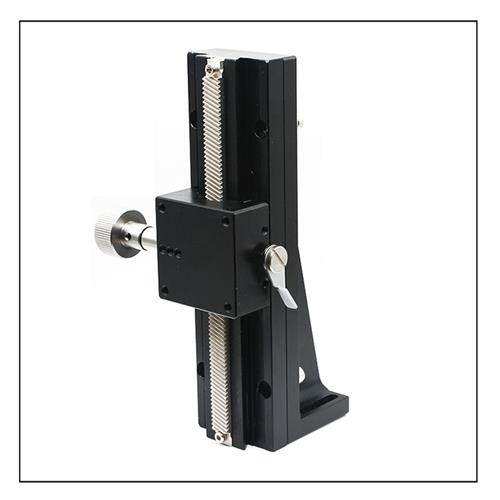
A dovetail slide uses angled sliding surfaces, usually machined directly into the aluminum or steel body. The carriage and base have matching male and female V-shaped ways. The large contact area spreads the load over a wide surface. This gives dovetail slides excellent rigidity and moment load capacity.
In a vertical manual stage, dovetails can handle heavy cantilevered loads without significant deflection. They are also easy to lock in place with a simple set screw or side clamp. If you need to hold a position for hours or days, a dovetail Z axis linear stage is often the best choice.
The trade-off is friction. Dovetail slides have higher friction than rolling-element guides. You may feel more resistance when adjusting. For manual operation with heavy loads, this is usually acceptable. But it is something to keep in mind if you plan to motorize later.
What Is a Crossed-Roller Z Axis Linear Stage?
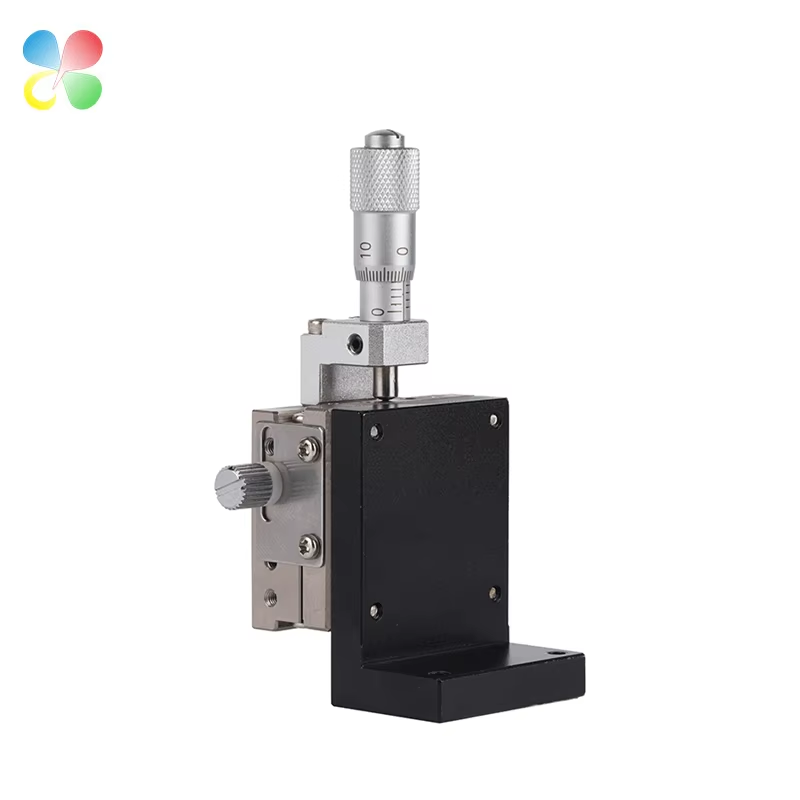
Crossed-roller guides use cylindrical rollers that alternate orientation between the V-groove rails. This arrangement provides line contact and low rolling friction. The result is extremely smooth motion with high stiffness.
A crossed-roller vertical manual stage excels when you need sub-micron adjustments. The motion is very predictable. There is almost no stick-slip. For applications like fiber alignment or sensor positioning, this smoothness directly improves manual lift stage precision.
The downside is that crossed-roller guides require careful handling. The rollers are held in a cage. In vertical orientation, that cage can creep downward over thousands of cycles if not designed properly. A well-engineered Z axis linear stage will have anti-cage-creep features. You should ask about this when comparing suppliers.
Head-to-Head Comparison Table
We have summarized the key differences in the table below. These numbers come from real testing on our own stages, using payloads between 10 kg and 50 kg.
| Feature | Dovetail Vertical Manual Stage | Crossed-Roller Z Axis Linear Stage |
| Typical Load Capacity (kg) | Up to 80 | Up to 40 |
| Moment Stiffness | Very high | High |
| Straightness (µm / 25 mm travel) | 3 – 8 | 1 – 3 |
| Friction Level | Moderate | Low |
| Self-Locking Ability | Excellent (with fine pitch screw) | Excellent (with fine pitch screw) |
| Smoothness of Adjustment | Good | Excellent |
| Maintenance Requirement | Low (occasional lubrication) | Medium (keep clean, monitor cage) |
| Relative Cost | Lower | Higher |
When a customer asks us the “Dovetail vs. crossed-roller vertical manual stage for Z axis linear stage heavy load” question, we always start with their application requirements. If the priority is maximum load capacity and clamping stability, we lean toward dovetail. If the priority is sub-micron positioning smoothness, we suggest crossed-roller.
There is no universal winner. There is only the right stage for your specific job.
Application Spotlight: Heavy-Load Precision Z Axis Linear Stage for Optical Alignment and Semiconductor Metrology
One area where we see increasing demand is heavy-load precision Z axis linear stage for optical alignment and semiconductor metrology. These applications require extreme stability.
In optical alignment, you might have a large mirror mount, a beam expander, or a heavy camera system. The Z axis linear stage must lift this mass smoothly and then hold it without any drift. Even a few microns of sag can shift the optical path and ruin measurements.
In semiconductor metrology, wafer inspection tools often use heavy sensor heads. The vertical manual stage must position the sensor precisely above the wafer surface. The height must be repeatable to within a micron or less. Any tilt or angular error creates inaccurate readings.
We have supplied stages for both these fields. Our customers consistently tell us the same thing: they cannot tolerate drift. They need manual lift stage precision that remains stable over an 8-hour shift. This is where the design choices we discussed earlier become critical. A fine-pitch lead screw, a stiff guide, and proper load centering make all the difference.
If you work in optical alignment or semiconductor metrology, you likely already know how unforgiving these environments are. The good news is that a properly specified heavy-load precision Z axis linear stage can deliver the performance you need. It just takes careful engineering and honest supplier communication.
Real-World Tips to Get the Best Manual Lift Stage Precision
Over nine years, we have learned a few practical tips that help our customers achieve better results with their vertical manual stage systems.
Lock the stage when not adjusting. Many of our dovetail vertical manual stages come with a side-locking mechanism. Use it. Even a self-locking lead screw can relax slightly over time due to vibration. A physical lock provides absolute security.
Check the mounting surface. A vertical manual stage mounted on a flexible bracket or uneven surface will never perform to its rated specifications. Use a rigid, flat base plate. We have seen manual lift stage precision double simply by switching to a solid steel base.
Lubricate correctly. Dovetail slides need a thin film of grease to glide smoothly. Too much grease attracts dirt. Too little causes jerky motion. We provide lubrication guidelines with every Z axis linear stage we ship. Following them will keep your stage performing for years.
Watch the environment. Temperature swings cause metal to expand and contract. In a precision vertical manual stage, even 2°C of change can shift the position by a few microns. If your lab has HVAC cycling, allow the stage to thermally stabilize before making critical alignments.
Test with your actual load. Static load ratings are useful. But nothing beats testing the stage with your real payload. We encourage all potential buyers to share their load details so we can help them choose the correct Z axis linear stage from the start.
Why Our Stages Fit Heavy-Load Challenges
We manufacture our full range of manual and motorized stages, including precision alignment platforms, in-house. This gives us control over every detail. The aluminum body is machined on our equipment. The lead screws are selected for the specific load case. The guides are assembled and adjusted by technicians who have been doing this for years.
When you contact us about a vertical manual stage, you are talking to the people who actually build them. We do not just resell catalog items. We can adjust travel lengths, choose different screw pitches, and even design custom brackets.
This matters when you need a heavy-duty Z axis linear stage that fits your exact setup. It also means we can honestly tell you if a standard product will work or if you need something tailored.
If you are currently comparing dovetail and crossed-roller options, or if you need to solve a specific manual lift stage precision challenge under a heavy cantilevered load, reach out to us. Describe your application. Tell us the load weight, the travel you need, and any accuracy targets. We will recommend a vertical manual stage that matches.
Frequently Asked Questions
1. How much load can a typical vertical manual stage handle?
It depends on the guide type. Our dovetail vertical manual stages handle up to 80 kg safely. Our crossed-roller Z axis linear stages typically handle up to 40 kg. We always recommend discussing the exact load and cantilever distance before ordering.
2. Can I upgrade a manual lift stage to motorized later?
In many cases, yes. A Z axis linear stage with a standard lead screw can be fitted with a motor and coupling. However, you need to consider if the guide and screw are suitable for the speed and duty cycle. We offer motorized versions of many manual platforms. Contact us to explore your options.
3. How do I ensure manual lift stage precision over time?
Regular maintenance is key. Keep the guides clean. Lubricate according to the manual. Check the locking mechanism periodically. If the stage begins to feel loose, it may need a gib adjustment (for dovetails) or roller cage inspection (for crossed-rollers). We provide support for all these procedures.
4. What is the difference between a Z axis linear stage and a lab jack?
A lab jack is a simple scissor-lift mechanism. It has no precision guide or fine-adjustment lead screw. A vertical manual stage provides controlled, measurable motion with high straightness and repeatability. Do not confuse the two if your application needs manual lift stage precision.
Let Us Help You Choose the Right Stage
You have read about the challenges of heavy loads on vertical stages. You understand the dovetail versus crossed-roller trade-off. You know how critical manual lift stage precision is in fields like optical alignment and semiconductor metrology.
Now it is time to find the right vertical manual stage for your specific setup.
Get in touch with our engineering team. Tell us your load, your travel range, and your accuracy requirements. We will help you choose between a dovetail and a crossed-roller Z axis linear stage, or we will design something custom if needed.
We have been doing this for over nine years. We have seen thousands of applications. Chances are, we have solved a problem similar to yours before.
Contact us today through our website form, email us directly, or call our sales office. Let us put a heavy-load precision Z axis linear stage on your bench that you can count on every day.
Post time: Jul-20-2026


